
Extended Essay

• The extended essay is compulsory for all students taking the DP and is an option for course students.
• The extended essay is a piece of independent research and writing on a topic chosen by the student in consultation with a designated supervisor in the school.
• The extended essay is presented as a formal piece of academic writing containing no more than 4,000 words accompanied by a reflective statement of no more than 500 words. The statement is included on the RPF.
• The essay is the result of approximately 40 hours of work by the student.
• Students are supported by a supervision process recommended to be three to five hours long, which includes three mandatory reflection sessions; the third and final reflection session is the viva voce, a concluding interview with the supervisor.
• The extended essay process helps to prepare students for the research-driven environment of
university or college.
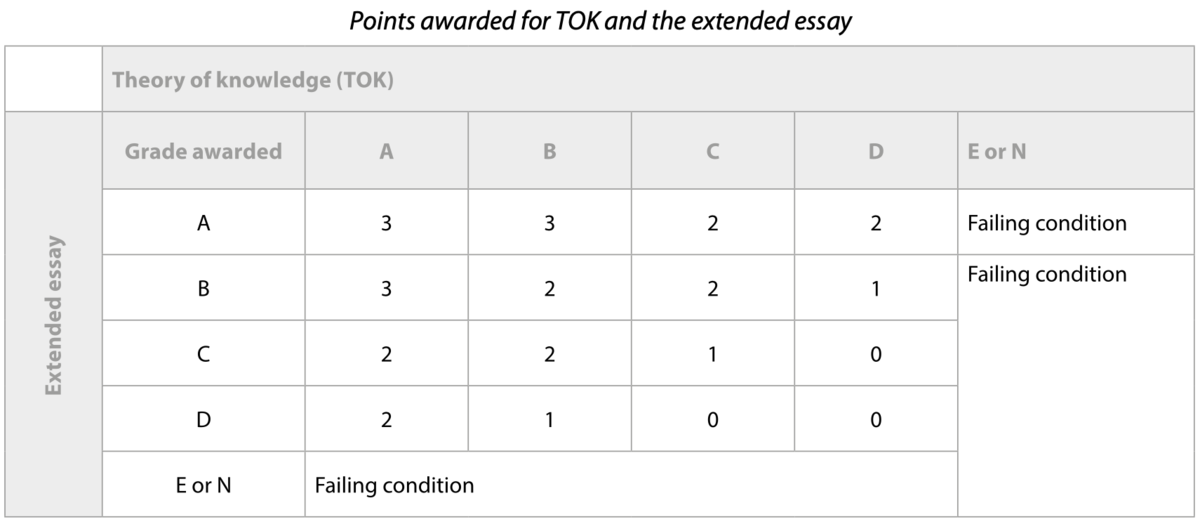
• A student must achieve a D grade or higher for the extended essay to be awarded the diploma.
• When choosing a subject for the extended essay, students must consult the list of available DP subjects published in the Diploma Programme Assessment procedures for the examination session in question.
| EE Timeline |
- 3 formal reflection sessions (mandatory)
- 3 informal "check-in" sessions
- provide students with advice & guidance in the skills of undertaking the research process
- encourage & support students throughout the research and writing of the extended essay
- discuss the choice of topic with each student and, in particular, help to formulate a well-focused research question which is suitable to the subject of registration and ensure that the chosen research question satisfies appropriate legal and ethical standards
- is familiar with the regulations governing the EE & assessment criteria and check that the student is conforming to any rules stated in the subject guide and is NOT "double-dipping" or using texts that are not permitted
- ensure the student understands the importance of using credible/accurate sources
- monitor the progress of the extended essay to offer guidance and to ensure that the essay is the student’s own work and the student has properly acknowledged all sources
- knows the student well
- shares the student's excitement and curiosity about the topic
- is comfortable establishing a clear work plan with the student
- follows up with timely feedback
| Student Reflection in the EE |
Reflection is an activity in which you recapture your experience and think about its impact on you as a
learner. This includes how you envisage transferring the skills and lessons you have learned to other
circumstances, including future studies, career or life in general.
• To assist you with this, there are 3 formal reflection sessions (Initial, Interim, Final-viva voce) with your supervisor.
• Your reflective thinking is recorded as a 500-word reflective statement that is written at the end of
the extended essay process.
• Keeping an ongoing record of your reflective thinking will support you in the writing of the reflective
statement.
The 500-word reflective statement
Your reflective thinking is recorded as a 500-word reflective statement, written at the end of the extended
essay process and included on your RPF. Keeping a thoughtful, regular record of your reflective thinking
along the way is essential to putting together a satisfying, effective reflective statement to accompany your
essay.
What resources can I use to help me write the reflective statement?
• My record of the viva voce
• My record of the other reflection sessions with my supervisor
• My completed extended essay
• My RRS or any other record of my reflective thinking
• Informal feedback from my supervisor and others
What might I address in my reflective statement?
• The main ideas discussed in the viva voce
• Learning skills I developed that I could use elsewhere as a learner
• Insights I gained from researching and writing the extended essay
• Changes in my perspective on the topic
• The impact of the choices I made during the extended essay process
• Experiences and insights that could shape my future thinking
space for you to write your 500-word reflective statement and will be submitted with your extended essay.
“Does the student evaluate the effect of the extended essay learning experience on them as a learner?”
examples.
• Reflection consistently shows evidence of the student’s growth and transfer of learning.
Evidence referred to in your reflection may be drawn from, but is not limited to, some of the following.
• Experiences and insights that could shape future thinking.
• Explicit examples of how skills learned could be used in other current contexts and in the future.
• How changes in perspective impacted decision-making.
| Assessment in the EE |
Assessment Criteria: 30 marks
Criterion A: Framework for the essay (6 marks)
-Focuses on research question AND research methods
-Structural conventions used to effectively communicate the research
Criterion B: Knowledge and understanding (6 marks)
-Knowledge (research materials used to establish knowledge of subject matter)
-Terminology used accurately AND concepts explained and used effectively
Criterion C: Analysis and line of argument (6 marks)
-Analysis is effective and produces relevant findings
-Line of argument links the RQ, research findings and conclusions
Criterion D: Discussion and evaluation (8 marks)
-Balanced discussion of significance of findings supported by evidence
-Evaluation of effectiveness of essay with relevant strengths and limitations explained
Criterion E: Reflection – 500-word statement (4 marks)
-Evaluative reflection on the learning experience
-Evidence of growth and transfer of learning
| Presentation in the EE |
The extended essay should be written in a clear, correct and formal academic style, appropriate to the subject from which the topic is drawn. Given that the extended essay is a formally written research paper, it should strive to maintain a professional, academic look.
To help achieve this, the following formatting is suggested.
-
- font, font size and spacing conducive to on-screen marking (ex. 12 point, Arial)
- page numbering (top right corner of the page)
- no candidate, supervisor, or school name on the title page, page headers, appendices or acknowledgment pages
- the file size must not be more than 10 MB. (Note that the RPF is uploaded separately and is not part of the overall file size of the essay.)
Submitting the extended essay in the required format will help set the tone of the essay and will aid readability for on-screen assessment by examiners.
| 6 Required Elements of the EE |
| Title Page |
Do NOT include your name, ONLY the following:
 |
| Contents Page | A contents page must be provided at the beginning of the extended essay and all pages should be numbered. Please note that an index page is not required and if included will be treated as if it is not present. |
| Introduction |
The introduction should tell the reader what to expect in the essay. The introduction should make clear to the reader the focus of the essay, the scope of the research, in particular an indication of the sources to be used, and an insight into the line of argument to be taken. While students should have a sense of the direction and key focus of their essay, it is sometimes advisable to finalize the introduction once the body of the essay is complete. |
| Body of the essay |
Research, analysis, discussion and evaluation: The main task is writing the body of the essay, which should be presented in the form of a reasoned argument. The form of this varies with the subject of the essay but as the argument develops it should be clear to the reader what relevant evidence has been discovered, where/how it has been discovered and how it supports the argument. In some subjects, for example, the sciences, subheadings within the main body of the essay will help the reader to understand the argument (and will also help the student to keep on track). In structuring their extended essay, students must take into consideration the expected conventions of the subject in which their extended essay is registered. Once the main body of the essay is complete, it is possible to finalize the introduction (which tells the reader what to expect) and the conclusion (which says what has been achieved, including notes of any limitations and any questions that have not been resolved). Any information that is important to the argument must not be included in appendices or footnotes/endnotes. The examiner will not read notes or appendices, so an essay that is not complete in itself will be compromised across the assessment criteria. |
| Conclusion | The conclusion says what has been achieved, including notes of any limitations and any questions that have not been resolved. While students might draw conclusions throughout the essay based on their findings, it is important that there is a final, summative conclusion at the end. This conclusion(s) must relate to the research question posed. |
|
Works Cited (MLA)
or
References (APA)
|
A bibliography is an alphabetical list of every source used to research and write the essay. Sources that are not cited in the body of the essay but were important in informing the approach taken should be cited in the introduction or in an acknowledgment. The bibliography must list only those sources cited.
"A citation is a shorthand method of making a reference in the body of an essay, either as an in-text citation or footnote/endnote. This must then be linked to the full reference at the end of the essay in the bibliography. A citation provides the reader with accurate references so that he or she can locate the source easily. How sources are cited varies with the particular referencing style that has been chosen. Page numbers should normally be given when referencing printed material and this is especially so in the case of direct quotations. For some styles this will also be in the citation, in others in the full reference. Once again, it is important to emphasize that there must be consistency of method when citing sources." |

| Contact Us |

| EE Resources |

| Academic Integrity |
| EE Writing Resources |
| Research Resources |
| Writing Tips |
- Don't procrastinate! Devise a plan to work on sections of your essay. Breaking it up into sections makes the writing process more manageable:
- Introduction - be sure to include the actual research question itself in the introduction, the factors being investigated to answer the question, the research subject-specific methodology/approach being used (the type of sources/data you intend to analyze in your own unique way) and why the topic is worth investigating.
- Body - your essay should continuously relate back to the research question in an attempt to answer it and should be broken up into various headings, and maybe even subheadings depending on your topic or subject. Use separate paragraphs under each heading/section to further break up/organize your discussion points. Be careful to avoid writing a narrative essay by simply "retelling" events - instead focus on analyzing the information you've gathered.
- Conclusion - is used to reiterate your key findings and how your points relate to the research question, any limitations regarding your research methods or sources, and to summarize your final analysis
- Works Cited (MLS) or References (APA) - cite as you write using in-text citations (using either MLA or APA referencing style) & provide an alphabetized list of the sources you actually used in your essay. Let Citation Machine do the hard work for you by properly formatting both your in-text & bibliography citations!
- Create an outline. It can help to organize your ideas. Try using Post-it Notes to rearrange your ideas until you find the order you'd like to present your discussion points/analysis
- Just start writing! You don't even need to begin writing in complete sentences. Just get something down on "paper" even if it's just bullet points. You can also write each section in whatever order you prefer. In fact, it's not uncommon to write the introduction section last!
- You're not looking for perfection with your 1st DRAFT. The goal is to write a complete draft so you can receive the BEST feedback since your supervisor can only read 1 draft. After your feedback session, you'll have the opportunity to make any edits or revisions to "perfect" your essay to your liking, and please reach out to me with any formatting or presentation questions!